Back Pain Home Physiotherapy In In: Clinical Triage And Recovery Plan
Author / Clinical Review
Dr. Krishna
Lead Consultant Physiotherapist
Posture correction home physiotherapy in Pune is most useful when neck pain, back pain, shoulder stiffness, headaches, or arm heaviness are no longer occasional discomforts and have started affecting work, sleep, driving, or daily movement. Many patients first describe it as a small problem: pain after laptop work, stiffness after meetings, or a heavy feeling between the shoulder blades by evening. The important clinical question is not simply whether posture looks good or bad. The question is why the body is repeatedly becoming painful in that posture and what needs to change for recovery to hold.
In Pune, this problem often has a very local shape. A patient may sit through long office hours in Hinjewadi, Kharadi, Magarpatta, or at home in Katraj, Kondhwa, Bibwewadi, NIBM, Warje, or Kothrud, then spend more time in traffic or on a two-wheeler. By the time treatment is considered, the neck, upper back, lower back, hips, and shoulders may all be involved. This guide explains how a physiotherapist reasons through posture-related pain at home, when red flags need medical review, how exercises are progressed, and what realistic recovery looks like.
When is posture pain more than normal work fatigue?
Normal work fatigue settles with movement, rest, hydration, and sleep. Posture-related pain becomes clinically relevant when it returns predictably, lasts longer than expected, spreads to nearby areas, or changes how you move. A common pattern is neck stiffness in the morning, shoulder tightness by afternoon, and lower back ache by evening. Some people also notice headaches from the back of the skull, jaw tightness, tingling in the arm, or a feeling that sitting upright takes too much effort.
A physiotherapist does not assess posture as a photo. A still photo can show forward head posture, rounded shoulders, or a slouched lower back, but pain usually depends on load, duration, tissue sensitivity, joint mobility, muscle control, sleep, stress, and how often the position is repeated. Two people can have similar sitting posture, but only one may be in pain. That is why posture correction physiotherapy in Pune should begin with clinical triage rather than a generic list of exercises.
What does clinical triage check during a home visit?
Clinical triage means sorting the problem safely before choosing treatment. During a home visit, the physiotherapist first listens to the symptom story: when pain started, what makes it worse, what reduces it, whether it is improving or worsening, and whether there was injury, fever, dizziness, numbness, weakness, or unexplained weight loss. The next step is movement testing. Neck rotation, looking up and down, shoulder elevation, thoracic mobility, lower back movement, hip flexibility, balance, and basic strength may all be checked.
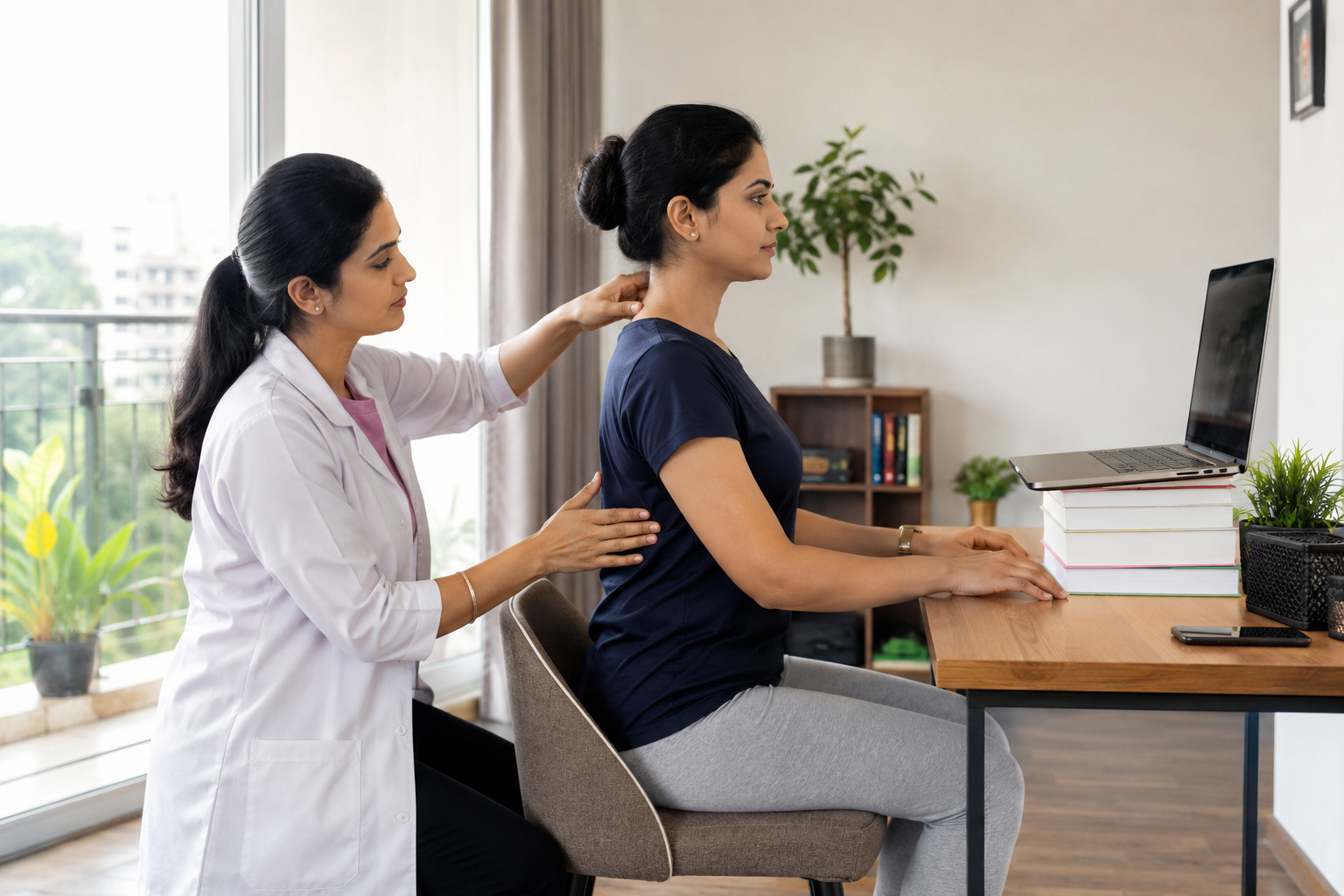
For desk workers, the physiotherapist also observes the real work setup. This is where home physiotherapy in Pune has a practical advantage. The therapist can see whether the laptop is too low, the chair is too deep, the feet are unsupported, the patient works from a sofa, or the monitor is placed to one side. They can also see how the patient gets up from the chair, bends to pick up a bag, uses a pillow, or sits during long calls. These small details often explain why pain returns after temporary relief.
Which symptoms suggest neck, upper back, or lower back involvement?
Posture-related pain is often described in broad language, but the pattern gives clues. Pain at the base of the skull with headaches may involve the upper cervical joints, muscle tension, screen position, or prolonged forward head posture. Pain between the shoulder blades may come from thoracic stiffness, weak scapular muscles, rounded shoulders, or repeated laptop reaching. Lower back ache after sitting may involve hip stiffness, poor pelvic control, reduced core endurance, or sensitivity from a disc or joint irritation.
Arm symptoms need closer attention. Tingling, numbness, burning, or weakness may indicate nerve irritation from the neck, shoulder region, or peripheral nerves. Leg pain with back pain may suggest sciatica or another lumbar nerve issue. In these cases, posture still matters, but the treatment plan must be more specific. Patients with strong leg symptoms can read more about sciatica pain relief and physiotherapy, while those with disc-related back pain may need a more cautious plan through slip disc physiotherapy.
What red flags should not be treated as simple posture pain?
Most desk-related neck and back pain is not dangerous, but a safe plan always screens for red flags. Seek medical review urgently if pain follows a major fall or accident, is associated with fever or unexplained illness, causes progressive weakness, affects walking balance, or comes with loss of bladder or bowel control. For neck pain, urgent review is also important if there is sudden severe headache, fainting, double vision, difficulty speaking, difficulty swallowing, drop attacks, or unusual dizziness linked with neck movement.
If there is numbness spreading into the arm or leg, worsening grip weakness, foot drop, night pain that does not change with position, or pain with a history of cancer or serious infection, physiotherapy should not continue as routine care until the concern is checked. Proper triage protects the patient and helps the family make the right decision. Proper Care has a related internal resource on cervical spine red flag screening that can support patient education, but it should not replace direct clinical assessment.
Why do posture correction exercises fail when they are chosen randomly?
Many patients search for posture correction exercises physiotherapy and start chin tucks, wall angels, neck stretches, or shoulder rolls. These may help some people, but they can also miss the reason pain is active. If the thoracic spine is stiff, the neck may keep overworking. If the shoulders lack control, the upper trapezius may stay tense. If the lower back is sensitive, aggressive extension or prolonged sitting cues may increase symptoms. If the patient has nerve irritation, repeated end-range stretching may worsen tingling.
The correct exercise is not only about the body part. It depends on irritability. A highly irritable neck may first need gentle pain-free movement and supported positions. A less irritable desk-worker pattern may tolerate strengthening earlier. A patient with long-standing stiffness may need mobility work before endurance training. A patient with repeated flare-ups may need load management before harder exercises. This is why physiotherapy for neck pain Pune should be matched to the symptom pattern, not copied from a generic video.
How is a recovery plan built after assessment?
A good recovery plan has phases. The first phase is symptom control and confidence. This may include gentle mobility, manual therapy when suitable, heat or cold guidance, supported rest positions, breathing, and simple movement breaks. If pain is sharp or easily aggravated, the therapist reduces the load before adding strengthening. The aim is to make daily activities tolerable, not to force perfect posture immediately.
The second phase is mobility and muscle control. The physiotherapist may work on neck mobility, thoracic extension, scapular control, hip mobility, and gentle core activation. Exercises are selected according to the patient. One person may need chin nods and deep neck flexor activation. Another may need rows, wall slides, thoracic rotation, or sit-to-stand control. A third may need lower back and hip work because the visible neck posture is only the final expression of a whole-body sitting habit.
The third phase is strength, endurance, and work tolerance. Desk workers do not only need to feel better during treatment. They need to sit, type, drive, lift a laptop bag, cook, sleep, and return to exercise without repeated flare-ups. Progression may include longer holds, resistance bands, graded strengthening, walking targets, workstation changes, and return-to-gym advice. This is where desk job back pain physiotherapy becomes more than pain relief. It becomes a plan to rebuild capacity.
What does a home physiotherapy session look like for posture correction?
A home session usually begins with a brief symptom review: what changed after the last visit, what activities were easier, what triggered pain, and whether any new symptoms appeared. The therapist then reassesses key movements, treats the most relevant restrictions, supervises exercises, and corrects technique. If equipment is suitable, portable tools such as TENS, IFT, ultrasound, resistance bands, or mobility aids may be used as part of the plan, but equipment is not the treatment by itself. The clinical decision behind it matters more.
An original clinic-media suggestion for this article would be a short 45 to 60 second video of Dr. Krishna showing three safe desk setup corrections during a home visit: laptop height, chair support, and a movement break drill. A second image could show a simple resistance-band upper back exercise supervised at home. Original clinic visuals would build more trust than stock images because Pune patients can see the actual home-visit context.
What locality patterns does Proper Care often need to plan around?
In South Pune, the treatment plan often has to account for travel strain, stairs, compact home spaces, and mixed work setups. A patient in Kondhwa or NIBM may work from a dining chair because the bedroom has poor internet. A patient in Katraj or Bibwewadi may travel by two-wheeler after long desk hours, adding neck and shoulder load. A patient in Warje or Kothrud may be able to exercise regularly but still flare up during long meetings because the monitor is placed too low.
This is an important information-gain point for local care: posture treatment is rarely only about exercise. It is about matching clinical advice to the actual Pune routine. For a home visit in Kondhwa, NIBM, Bibwewadi, Kothrud, or Warje, the therapist can adapt exercises to the patient's space, chair, commute, family routine, and available time. This makes the plan easier to follow between sessions.
How should pain be managed while posture is improving?
Patients often believe that pain must be fully gone before exercise starts. In many posture-related cases, that is not necessary. The safer rule is to work within a tolerable range. Mild discomfort during exercise can be acceptable if it settles quickly and symptoms are not worse later in the day or the next morning. Sharp pain, spreading symptoms, tingling, dizziness, or weakness are different and should be reassessed.
Load management is the bridge between rest and recovery. Instead of stopping all work, the therapist may advise shorter sitting blocks, supported calls, alternating sitting and standing, reducing laptop-on-bed work, and scheduling movement breaks before pain peaks. For work from home neck pain Pune patients, one helpful target is to move before stiffness becomes pain. Waiting until the neck is already painful makes recovery harder.
What role do caregivers or family members play?
For younger desk workers, the caregiver role may simply be helping adjust the workstation or reminding the patient to avoid late-night laptop use from bed. For elderly patients, post-surgery patients, or those with neurological conditions, the family role is larger. They may need to help with safe walking space, chair height, exercise timing, fall-risk reduction, and tracking changes in pain or function.
Home safety matters even for posture care. A low sofa can worsen back strain. A very high pillow can irritate the neck. Poor lighting can increase fall risk for older adults. A cluttered exercise space can make balance drills unsafe. When posture issues overlap with age-related weakness, patients may also benefit from physiotherapy for elderly patients. If posture pain follows surgery, the plan should be coordinated with post-operative rehabilitation.
What progress markers are more useful than perfect posture?
Perfect posture is not the best recovery goal. More useful markers include sitting 30 to 45 minutes with less pain, turning the neck while driving without stiffness, fewer headaches, reduced evening shoulder tightness, better sleep, improved walking tolerance, and confidence with exercises. For lower back pain, a good marker may be easier sit-to-stand movement or less pain after a full workday. For neck pain, it may be better rotation, fewer painkillers, or less arm heaviness.
Recovery speed varies. A simple recent stiffness pattern may improve within a few sessions if the patient changes the work setup and follows exercises. Long-standing pain, nerve sensitivity, poor sleep, high work stress, or repeated flare-ups may need a longer plan. The honest aim of home physiotherapy for posture correction Pune is not an instant cure. It is safer movement, clearer diagnosis, better capacity, and a plan the patient can continue.
Suggested blogs and service pages for deeper reading
Patients with posture-related back pain can read Expert Back Pain Physiotherapy in South Pune for a spine-focused overview. Patients whose neck or back symptoms include nerve pain may also benefit from the pages on sciatica treatment and slip disc physiotherapy. If the main need is convenience, safety, and treatment planning at home, start with Home Physiotherapy in Pune.
For patients comparing nearby access, Proper Care also has local pages for Ambegaon Budruk, Bharati Vidyapeeth Area, and Narhe. These pages are useful when the main question is whether a home visit can be arranged in a specific part of Pune.
FAQ: posture correction home physiotherapy in Pune
Can physiotherapy really correct posture or only reduce pain?
Physiotherapy can improve posture-related pain, movement control, strength, and body awareness, but it does not force one fixed posture. The goal is to reduce strain, improve mobility, build endurance, and help the patient tolerate daily work better. Lasting change depends on exercise consistency and habit changes.
How many sessions are needed for desk-job neck or back pain?
The number of sessions depends on pain duration, irritability, nerve symptoms, strength, work routine, and how well exercises are followed. Recent mild stiffness may need fewer sessions, while long-standing pain or repeated flare-ups usually need a longer plan with reassessment and progressive loading.
Is home physiotherapy better than visiting a clinic for posture correction?
Home physiotherapy is helpful when the problem is linked to the patient's real chair, desk, laptop, sofa, bed, or daily routine. A clinic can still be useful, but a home visit allows the therapist to correct the environment where pain is repeatedly triggered.
Should I stop working out if I have posture-related neck pain?
You do not always need to stop exercise, but you may need to modify it. Heavy overhead lifting, aggressive stretching, or painful movements may need a temporary change. A physiotherapist can guide safe loading so fitness continues without repeatedly irritating the neck or back.
When should you book a home assessment?
Book a home physiotherapy assessment if neck pain, back pain, shoulder stiffness, headaches, or posture-related discomfort is affecting work, sleep, driving, or daily movement. It is also sensible to book if symptoms keep returning despite stretches, ergonomic changes, or rest. A home assessment helps identify whether the main issue is posture load, joint stiffness, muscle weakness, nerve irritation, work setup, or a combination.
Proper Care Physiotherapy provides physiotherapist at home Pune support for posture-related neck and back pain, with treatment planned around clinical assessment and the patient's actual home environment. To start, call or WhatsApp Proper Care Physiotherapy and book a home visit. Share your main symptoms, location in Pune, work routine, and any red flags so the first session can be planned safely and practically.
Clinical References
These references support the clinical education on this page. They do not replace an individual assessment or medical advice from your treating doctor.
- Rehabilitation World Health Organization
- Low back pain and sciatica in over 16s: assessment and management National Institute for Health and Care Excellence
- Neck Pain American Academy of Orthopaedic Surgeons
- Back Pain Physiotherapy at Home Pune Proper Care Physiotherapy
Medical Disclaimer
This article is for educational awareness and should not replace an in-person medical assessment, diagnosis, or emergency care. If symptoms are severe, rapidly worsening, or medically urgent, please contact the appropriate doctor or emergency service immediately.
Focus Keywords
Suggested Blogs
Reviewed By Clinical Expert

Dr. Krishna
Lead Consultant Physiotherapist
This article is published for patient education and reviewed with a clinical home-physiotherapy perspective focused on neuro rehabilitation, orthopedic care, and mobility recovery in Pune.
Need Help Choosing The Right Home Physiotherapy Plan?
Speak with Proper Care Physiotherapy for symptom guidance, home-visit availability, and a faster path to the right recovery plan in Pune.